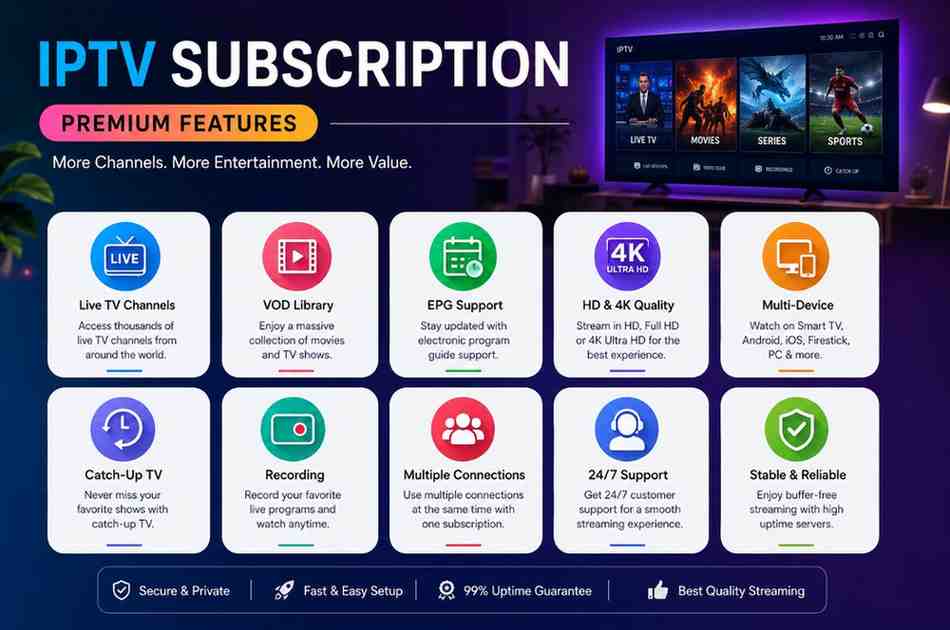
Buying an IPTV subscription means paying a provider — typically $8 to $20 per month — to stream live television channels, sports, news, and on-demand movies over the internet instead of through cable or satellite. The safest way to buy in 2026 is to choose a provider with a free trial, transparent pricing, and broad device support (Smart TV, Firestick, Android, iOS, and PC). A quality IPTV plan delivers 10,000+ live channels, 40,000+ VOD titles, and stable 4K/FHD streams on a 20 Mbps connection. This guide covers what to verify before paying, realistic costs, legal considerations, and how to avoid unreliable resellers.
buy iptv subscription Summary
An IPTV subscription is an internet-delivered television service that streams live channels, sports, and on-demand movies directly to any smart device without requiring cable hardware or long-term contracts. The proven benefit is cost efficiency: most buyers reduce their monthly TV bill by 60–80% while gaining access to a significantly larger global content library.
| Optimal ForCord-cutters, international households, and sports fans who want premium live content without cable pricing. | Key Advantage10,000+ live channels and 40,000+ VOD titles on a single login across Smart TVs, Firesticks, phones, and laptops. |
- ✓ Key Strength: Multi-device compatibility: Android, iOS, Smart TV, Firestick, MAG, Windows, and Mac apps included with every plan.
- ✓ Key Strength: Flexible billing: month-to-month pricing with no lock-in; PayPal, credit card, and crypto accepted by reputable sellers.
- ✓ Peace of Mind: 24/7 client support with setup guidance, plus a 24-hour free trial that mirrors the paid plan before you commit.
In This Guide
How IPTV Subscriptions Actually Work in 2026
IPTV (Internet Protocol Television) replaces conventional broadcast infrastructure with over-the-internet delivery. Instead of coaxial cables or satellite dishes, the provider streams encoded video packets to an application on your device. In practice, you receive login credentials (or an M3U playlist link / Xtream Codes API URL) that the app uses to fetch live channels, video-on-demand (VOD), and the electronic program guide (EPG) from the provider's servers. Activation typically takes 15–30 minutes after payment confirmation.
Two distinct market segments matter when you buy an IPTV subscription. Licensed IPTV services — YouTube TV, Hulu + Live TV, Sling, and their international equivalents — hold legal distribution rights and price plans at $40–$80/month. Unlicensed IPTV providers, which dominate the "$12/month for 15,000 channels" market, aggregate premium channels without direct licensing agreements. This grey-market model explains both the dramatic price difference and the volatility of the provider landscape: domains change frequently, and server infrastructure determines your experience far more than the channel list does.
What Actually Determines Stream Quality
Four server-side factors shape your viewing experience once you buy IPTV subscription access. Server load balancing determines whether popular channels buffer during peak hours (7–11 PM); reputable providers spread traffic across multiple dedicated servers. Bitrate caps govern picture sharpness — a 10 Mbps per-channel cap produces pixelation on 60-inch displays, while 4K FHD streams require 20–30 Mbps sustained throughput. EPG accuracy influences usability: without reliable program data for the next 7–14 days, channel browsing becomes guesswork. Protocol efficiency also matters; providers using modern HTTP-based delivery with adaptive bitrate switching outperform older UDP-based systems on unstable connections.
Pre-Purchase Checklist Before You Pay
Experienced buyers apply the same diligence whether they are choosing a $9 plan or a $200 yearly package. Confirm the provider offers a free trial of at least 12 hours — and test it during evening prime time, not midday. Verify the channel list is publicly displayed with categories, languages, and the specific sports packages you care about. Ask whether the provider uses a mainstream platform (Xtream Codes API, M3U, or a dedicated reseller panel), because proprietary apps are a common red flag for short-lived operations. Finally, check support responsiveness: send a pre-sales question via WhatsApp or Telegram and measure the reply time. A provider that ignores inquiries before payment will not help you after it.
There is also a frequently overlooked operational reality: your device choice and network configuration determine most of your satisfaction. Firestick and Android TV devices tend to perform best because the most mature IPTV player apps (TiviMate, IPTV Smarters Pro, Kodi with PVR add-ons) are native to those platforms. Smart TV app availability is occasionally limited to specific brands or firmware versions, so confirm application support for your exact TV model before buying.

IPTV Subscription: Pros, Cons, and Plan Comparison
Every buyer should weigh the structural trade-offs before purchasing. The following comparison isolates the variables that separate legitimate, stable IPTV providers from temporary resellers.
✓ What Works Well
- Cost efficiency: $8–$20/month vs $75–$150+ for cable bundles.
- Content library: 10,000+ channels and 40,000+ VOD titles, including international and niche programming.
- Flexibility: month-to-month plans, cancel anytime, no equipment rental fees.
- Device support: Firestick, Smart TV, Android, iOS, MAG, PC — one subscription covers them all.
✗ Watch Out For
- Legal gray zone: unlicensed content may be blocked or throttled in some regions; use a VPN for privacy.
- Server variability: stream quality depends entirely on provider infrastructure investment.
- Internet dependency: requires a stable connection of at least 25 Mbps for reliable 4K playback.
- Scammer risk: sellers without trials or working support channels frequently disappear after payment.
2026 IPTV Subscription Plan Tiers Compared
| Feature / Metric | Entry Plan | Standard Plan | Premium Plan |
|---|---|---|---|
| Monthly Price | $8–$12 | $12–$16 | $16–$20 |
| Live Channels | 5,000–8,000 | 10,000–15,000 | 15,000–20,000+ |
| Movies & Series | 10,000 VOD | 40,000–60,000 VOD | 60,000–80,000+ VOD |
| Stream Quality | 720p / 1080p | 1080p / 4K FHD | 4K FHD / HDR |
| Simultaneous Connections | 1 device | 1–2 devices | 2–4 devices |
| Program Guide (EPG) | 7-day EPG | 7-day EPG | 14-day EPG |
| Support | Email + Live Chat | 24/7 Live Chat + WhatsApp | |
| Trial | 12–24 hours | 24 hours | 24–48 hours |
A premium plan adds minimal cost relative to the entry tier, so most households find the standard tier is the price-performance sweet spot. If you need multiple room streams simultaneously, the premium tier's additional connections justify the difference.
Cost-Benefit Analysis and Who Should Buy
The total cost of ownership is where IPTV decisively outperforms cable. A typical US cable subscription with premium channels runs $95–$140 per month. On a yearly basis, that is $1,140–$1,680. A premium IPTV subscription at $18/month costs $216 per year — a savings of roughly $900–$1,460 annually, before accounting for equipment rental fees and regional sports surcharges that cable companies add. Even against streaming-aggregated services (Netflix + Max + ESPN+ + Sling), a $15 IPTV plan frequently delivers more live channels and pay-per-view events at a comparable total price.
Who Should Buy IPTV Subscription Access
Ideal candidates include sports enthusiasts who want multiple regional and international sports packages without paying for tiered cable sports add-ons; households that watch content in multiple languages, where IPTV's international channel blocks outperform any single US streaming service; and budget-conscious cord-cutters who prioritize content breadth over the polish of a licensed platform. IPTV also suits travelers, since most providers allow connections from different IP locations and work with VPNs for overseas streaming.
Who Should Skip Buying
If your home internet connection delivers less than 10 Mbps during peak hours, or you require user profiles, offline downloads, and Netflix-style recommendation algorithms, a licensed IPTV service or conventional streaming platform is a better investment. Similarly, buyers in countries with aggressive copyright enforcement should factor in VPN costs ($3–$5/month) — which still leaves IPTV cheaper than cable, but changes the effective monthly outlay.
Red Flags That Should End the Sales Process
- No free trial. A provider that cannot risk a 12-hour trial has no confidence in its own infrastructure.
- Crypto-only payment. Legitimate sellers accept PayPal and cards, giving you chargeback protection.
- Unrealistic pricing. Under $5/month for "all channels" is a harvesting operation or a reseller who will vanish within weeks.
- No public channel list. Without transparency on channel categories and languages, you cannot verify the actual deliverable.
- No support channel reachable within hours. Unresponsive support before purchase guarantees unresponsive support after it.
The Bottom Line on Iptv Subscription
If you want maximum content variety for a fraction of cable pricing and have a stable 25 Mbps+ internet connection, buying an IPTV subscription from a provider that offers a free trial and live support is a sound, low-risk choice. Proceed only with sellers who publish channel lists, accept mainstream payment methods, and respond quickly to pre-sales inquiries.
Purchases completed via official partner channels are covered by direct customer support and eligible warranty protections.
Frequently Asked Questions
Is buying a lifetime IPTV subscription worth it?
Avoid lifetime IPTV subscriptions. The average grey-market IPTV provider changes domains or shuts down within 12–18 months, which means most lifetime buyers either lose their money or are forced to rebuy from a new provider. Month-to-month plans are the safer financial choice, and reputable providers typically offer discounts for 3-, 6-, and 12-month upgrades.
How much does an IPTV subscription cost in 2026?
Expect to pay $8–$12 per month for a basic plan with 5,000–8,000 channels, $12–$16 per month for a standard plan with 10,000+ channels and 4K streams, and $16–$20 per month for premium access with 20,000+ channels, multi-device support, and priority server routing. Yearly plans usually cost between $70 and $150.
What internet speed do I need for IPTV?
A stable 25 Mbps connection works reliably for 1080p and 4K streams on one device; 50 Mbps or higher is recommended when multiple household devices stream simultaneously. Ping and packet loss matter more than raw download speed — use a wired Ethernet connection or a strong 5 GHz Wi-Fi signal for consistent playback.
Is buying an IPTV subscription legal?
Legality depends on the content source and your country. Licensed IPTV services (YouTube TV, Hulu + Live TV, Sling) are 100% legal. Unlicensed providers that resell premium channels without distribution rights operate in a legal gray zone in most jurisdictions — consumers rarely face prosecution, but the practice is subject to copyright enforcement, so use at your own discretion and ideally behind a VPN.
Can I use a VPN with my IPTV subscription?
Yes. Running a reputable VPN on your device before launching the IPTV app encrypts your traffic and prevents ISPs from throttling streaming services. Some IPTV providers also require a VPN to unlock geo-restricted content, and using one protects you from copyright notices in stricter regions. Choose a VPN with dedicated streaming servers and WireGuard or OpenVPN protocols.
What devices are compatible with IPTV subscriptions?
Virtually all modern devices work: Amazon Fire TV Stick, Android TV boxes, Apple TV, Smart TVs (Samsung, LG, Sony), Android and iOS phones, Windows/Mac PCs, and MAG boxes. Most providers activate two to five simultaneous connections, and you typically receive setup credentials plus a guided installation walkthrough for your primary device.
How can I verify an IPTV provider is reliable before buying?
Ask for a free trial (12–48 hours) and test the stream during peak evening hours. Check whether the provider publishes a full channel list and EPG; verify they use a mainstream Xtream Codes or M3U setup; confirm they maintain active Telegram/WhatsApp support with real representatives; and review independent feedback on forums like Reddit's r/IPTV before committing.
What happens if the IPTV service buffers or goes down?
Buffering is usually caused by the provider's server load — not your internet — so test multiple premium channels during prime time. Reputable providers maintain redundant servers, offer connection resets, and extend subscription time when outages occur. If a provider disappears without replacement credentials and stops responding, contact your payment channel (PayPal or card issuer) to dispute the charge.
Transparency & Disclosure: We independently evaluate products. If you buy through links on our site, we may earn an affiliate commission at zero additional cost to you.