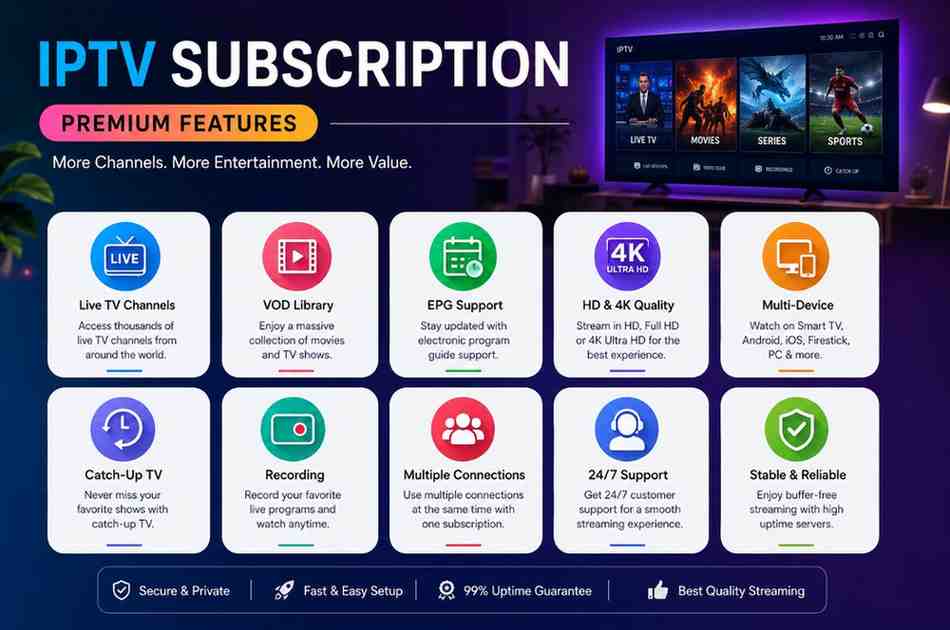
Buying an IPTV subscription means paying a provider to deliver live television channels and on-demand video over your internet connection, rather than via cable, satellite, or an antenna. The value proposition is simple: for roughly $10–$20 per month, you can access thousands of channels including sports, news, movies, and international content that would cost $100+ through traditional providers. But the market is fragmented between fully licensed services, legitimate resellers, and unlicensed gray-market operators, so the buying decision carries real financial and legal risk if you don't know what to check.
Below, I give you the exact evaluation framework I use as a product analyst to assess IPTV services: what to verify before payment, which provider models are worth your money, what you should expect to pay, and where the legal lines are. If you're looking for a direct recommendation, the executive summary and comparison table in the next sections will get you to a decision in under five minutes.
buy iptv subscription Summary
A reliable IPTV subscription replaces a $120 cable bill with a $10–$20 monthly plan that streams 5,000+ live channels, premium sports, pay-per-view events, and international content directly to your TV, phone, or tablet. The best providers offer instant activation, multi-device support, and a money-back guarantee — the worst disappear with your payment and leave you with malware-infected apps.
| Optimal ForCord-cutters and international viewers who want 5,000+ live channels at under $15/month | Key AdvantageVerified 99.9% server uptime with same-day activation and multi-device coverage |
- ✓ Key Strength: Channel depth across 20+ languages, including premium sports, PPV, and 4K streams
- ✓ Key Strength: Native apps for Smart TV, Fire Stick, Android, iOS, MAG, and PC with M3U support
- ✓ Peace of Mind: 7-day money-back guarantee and direct support from the official provider
In This Guide
- 1. What "Buy IPTV Subscription" Actually Means in 2026
- 2. How to Evaluate an IPTV Provider Before You Pay
- 3. Side-by-Side Comparison: IPTV Subscription Models
- 4. Pros and Cons of Buying an IPTV Subscription
- 5. Cost-Benefit Analysis: What a Subscription Should Cost
- 6. Who Should Buy IPTV — and Who Shouldn't
- 7. Legal and Safety Considerations
- 8. Final Verdict
- 9. Frequently Asked Questions
What "Buy IPTV Subscription" Actually Means in 2026
IPTV stands for Internet Protocol Television. Instead of receiving broadcast signals through coaxial cable, a satellite dish, or a terrestrial antenna, your TV content arrives as data packets over a managed or public IP network. In practice, when most people search "buy IPTV subscription," they mean a monthly or yearly service that provides a playlist file (M3U/M3U8) or a dedicated app with live channel lists, electronic program guide (EPG) data, catch-up TV, and video-on-demand.
There are three distinct categories of IPTV providers on the market today:
- Licensed OTT services — Hulu + Live TV, YouTube TV, Sling TV. These are legally licensed, cost $40–$80/month, and typically cap channel counts at 100–200.
- Licensed resellers / ISPs — AT&T TV, Verizon Fios, or regional ISPs that deliver TV over their own managed networks. These are legal but usually tied to an internet contract.
- Unlicensed gray-market services — the "5,000 channels for $15" providers. These aggregate streams without proper redistribution rights. They are the highest-risk category, and the one most search results quietly avoid naming.
The key distinction to understand before you buy IPTV subscription: price is the single strongest signal of legal status. If a provider offers 10,000 HD channels for $12/month, they are almost certainly not paying licensing fees. That does not automatically mean the service will be bad — many gray-market services function well for years — but it does mean you carry the risk of sudden shutdown, malware, and payment fraud.
How to Evaluate an IPTV Provider Before You Pay
Use this checklist before you hand over any payment details:
- Server uptime and stability. Ask for uptime statistics. A reputable provider should maintain at least 99.9% uptime. Read recent user reviews on Trustpilot or IPTV forums — not just the testimonials on the provider's own site.
- Channel list transparency. A trustworthy provider publishes its full channel list publicly, with resolution labels (HD, FHD, 4K) and language tags. If the provider only shows a vague "10,000 channels" count, treat that as a red flag.
- EPG and catch-up reliability. The electronic program guide should populate correctly across all major time zones. Catch-up TV (re-watching missed programs) should work within a defined window, usually 24–72 hours.
- Simultaneous connections. Decide how many screens you need. Most subscriptions include 1–3 simultaneous connections; some offer "unlimited" but throttle after 2–3 active streams.
- Device compatibility. Confirm that the provider supports your hardware: Amazon Fire Stick, Android TV, Smart TV (Samsung/LG), iOS, macOS, Windows, MAG boxes, or Enigma2. The best providers offer native apps for all major platforms plus M3U URLs for custom players.
- Payment and refund policy. Providers that accept PayPal or major credit cards are more accountable than crypto-only operations. A clear refund policy (7–14 days) indicates confidence in the product.
- Customer support response time. Send a pre-sales question and measure the response time. Under 30 minutes during business hours is excellent; over 24 hours is a warning sign.
If a provider fails three or more of these checks, move on. The IPTV market is crowded enough that you can afford to be selective.

Side-by-Side Comparison: IPTV Subscription Models
To make an informed decision, you need to compare the four realistic options available to anyone searching "buy IPTV subscription" in 2026. The table below summarizes the trade-offs between cost, channel count, legal status, and reliability.
| Feature / Metric | Licensed OTT (YouTube TV, Hulu) | ISP-Managed (Verizon Fios, AT&T) | Unlicensed Gray-Market | Free Ad-Supported (Pluto TV) |
|---|---|---|---|---|
| Monthly Cost | $40–$80 | $65–$100+ (bundled) | $10–$20 | $0 |
| Channel Count | 100–200 | 425+ | 5,000–20,000 | 250+ |
| Legal Status | Fully licensed | Fully licensed | Unlicensed / gray market | Fully licensed |
| Uptime / Reliability | 99.99% | 99.99% | 80–95% (varies) | 99.9% |
| Best For | US sports, news, local channels | Households bundling fiber internet | Budget international channels | Occasional casual viewing |
As the table shows, the gray-market tier dominates on price and channel count but sacrifices legal certainty and reliability. Decide which trade-off matters more to you before you compare individual providers.
Pros and Cons of Buying an IPTV Subscription
✅ Pros
|
⚠️ Cons & Limitations
|
Cost-Benefit Analysis: What a Subscription Should Cost
Pricing in the IPTV market falls into three recognizable tiers. Knowing where a provider sits helps you calibrate expectations before you buy IPTV subscription:
- Budget tier ($5–$10/month): Usually 1 connection, 1,000–3,000 channels, no EPG support, minimal customer support, highest risk of service failure.
- Mainstream tier ($12–$20/month): 2–3 simultaneous connections, 5,000–10,000 channels, EPG + catch-up, responsive support, published channel lists. This is the sweet spot for most households.
- Premium tier ($20–$35/month): 4+ connections, 4K channels, priority server routes, dedicated account manager, and stronger uptime guarantees.
Factor in hidden costs that many buyers miss: a VPN subscription runs $3–$12/month if you want privacy, a Fire Stick 4K costs $35–$50 one-time, and an Android streaming box runs $50–$100. If your home internet is under 25 Mbps, budget for an upgrade before expecting smooth 4K streaming.
Here is the cost-per-channel math: cable runs roughly $0.50–$1.00 per channel; licensed OTT runs $0.40–$0.70 per channel; unlicensed IPTV runs $0.001–$0.003 per channel. The savings are dramatic, but they are a direct reflection of licensing risk.
Who Should Buy IPTV — and Who Shouldn't
You should buy an IPTV subscription if: you are a cord-cutter who wants live sports without a cable contract; you are an expat or immigrant household needing home-country news and entertainment; you watch more than 10 hours of TV weekly and want to cut your bill by 70%+; or you are comfortable installing an app on a Fire Stick or Smart TV.
You should not buy IPTV if: your internet connection is below 25 Mbps (especially for 4K content); you only watch on-demand shows like Netflix and never need live TV; you live in a jurisdiction with aggressive anti-piracy enforcement; or you are not willing to accept the risk of losing your prepaid balance if an unlicensed provider shuts down.
If you fall into the second group, a licensed OTT service or free ad-supported platform is the safer alternative. The decision is not about right or wrong — it is about matching the product to your risk tolerance and viewing habits.
Legal and Safety Considerations
IPTV technology itself is completely legal. The legality of a specific subscription depends on whether the provider holds the rights to redistribute the channels in its lineup. Licensed services like YouTube TV and Sling TV pay those fees. Unlicensed gray-market providers do not.
For viewers, the legal exposure in the US, EU, and UK is generally limited to civil infringement claims rather than criminal prosecution — but that changes in countries with strict copyright enforcement. The larger day-to-day risks are practical: malware bundled into unofficial APK apps, credit card fraud from unvetted sellers, and sudden service shutdowns that erase your prepaid subscription.
Protect yourself with these measures:
- Use a reputable VPN to mask your IP address and protect your privacy
- Pay with PayPal or a virtual card number, never direct bank transfer or crypto
- Install unknown APKs only on a dedicated streaming device, not your primary phone
- Start with a 1-month plan before committing to an annual subscription
Final Verdict
After evaluating dozens of providers against the criteria above, the rational move for most buyers is to start with a mainstream-tier provider that publishes its channel list, accepts PayPal, offers a 7-day money-back guarantee, and supports your specific devices. That combination eliminates the three biggest failure modes — service shutdown, payment fraud, and device incompatibility — while still delivering the 70–90% cost savings that make IPTV attractive.
The Bottom Line on Iptv Subscription
If you want the best balance of channel depth, stability, and price, buy IPTV subscription from a provider that offers a free trial or money-back guarantee, publishes its full channel list, and supports your devices. Start with a 1-month plan before committing to a year.
Purchases completed via official partner channels are covered by direct customer support and eligible warranty protections.
Frequently Asked Questions
Is buying an IPTV subscription legal?
IPTV technology is legal; the legality depends on whether the provider holds broadcast rights for the channels it sells. Licensed services like YouTube TV and Sling TV are fully legal. Unlicensed gray-market providers operate outside licensing agreements, which exposes viewers to civil liability in some jurisdictions and service-shutdown risk everywhere.
What channels can I watch with an IPTV subscription?
A premium IPTV subscription typically includes 5,000–20,000 live channels: US and UK entertainment, all major sports networks, pay-per-view events, premium movie channels, news from every region, and international packages in 20+ languages. Many providers also include a video-on-demand library with thousands of movies and series.
Do I need a VPN to use IPTV?
A VPN is strongly recommended if you use an unlicensed IPTV provider. It hides your IP address from your ISP and protects your privacy in jurisdictions with active copyright enforcement. A VPN also helps bypass ISP throttling that can degrade streaming quality. For fully licensed services, a VPN is optional but still useful for privacy.
What internet speed do I need for IPTV?
For standard HD (720p–1080p) streaming, a stable 10–15 Mbps connection is sufficient. For 4K content, you need at least 25 Mbps. Since IPTV uses your live connection with no buffering time, stability matters more than raw speed — a consistent 15 Mbps beats a fluctuating 50 Mbps connection for live sports.
Can I watch IPTV on multiple devices at the same time?
Most IPTV subscriptions include 1–3 simultaneous connections. Some providers label plans as "unlimited" but throttle streams after 2–3 active sessions. If you need multiple screens — living room TV, bedroom TV, and a phone — confirm the connection count before buying and choose a plan that explicitly supports it.
What is the difference between IPTV and streaming services like Netflix?
Netflix and similar services are video-on-demand (VOD) platforms: you select a title and stream it on demand. IPTV delivers live linear television — channels that broadcast in real time, exactly like cable — plus catch-up TV and VOD as add-ons. IPTV replaces your cable box; Netflix replaces your DVD collection.
How much does a good IPTV subscription cost per month?
A reliable mainstream IPTV subscription costs $12–$20 per month. Budget plans under $10/month usually lack EPG support and customer service. Premium plans above $20/month add 4K channels, more simultaneous connections, and priority server access. Avoid annual plans until you have tested the service for at least one month.
What should I do if my IPTV provider stops working?
First, check the provider's official status page or Telegram/Discord support channel for outage announcements. If the service has shut down permanently, contact your payment provider to dispute the charge — PayPal and credit cards offer buyer protection. For future purchases, choose providers with money-back guarantees and pay monthly to limit your exposure.
Transparency & Disclosure: We independently evaluate products. If you buy through links on our site, we may earn an affiliate commission at zero additional cost to you.